OKR Implementation Framework for UAE Organisations

OKR Implementation Framework for UAE Organisations

Effective OKR implementation is essential for UAE companies that want to build alignment, improve execution, and create a high‑performance culture. Many organisations struggle with OKRs because they start without a clear process or the right tracking software. At Zephora Consulting, we deliver a proven OKR implementation framework for UAE organisations, integrating your goal-setting structure directly into your CRM to ensure OKRs become a sustainable, measurable part of your business system.

Step 1 — Strategy Discovery for OKR Implementation

Every successful OKR cycle starts with clarity, not software. We work with leadership to understand your strategic priorities and growth targets before a single objective gets written, so OKRs reflect real business direction instead of becoming disconnected task lists. For the full breakdown of this phase, see our OKR Implementation Roadmap.

Step 2 — OKR Design Workshops

Once strategy is clear, we run structured workshops with leadership and department heads to shape objectives, key results, and initiatives that actually connect across teams. Full detail on how we run these sessions is covered in our OKR Implementation Roadmap.

Step 3 — CRM Setup for OKR Implementation

This is where implementation stops being theoretical. Once objectives are set, we build them directly into your OKR platform so tracking, visibility, and accountability happen automatically instead of living in scattered spreadsheets.

What we configure inside your platform:

  • Department-specific OKR templates — pre-structured formats so every team writes objectives and key results in a consistent, measurable way from day one
  • Goal alignment maps — a visual hierarchy showing exactly how individual and team objectives ladder up to company-level goals, so anyone can see how their work connects to strategy
  • Live KPI dashboards — real-time progress bars and confidence scores for every key result, visible to managers and leadership without needing a status meeting to find out where things stand
  • Automated weekly check-in workflows — the platform prompts each owner for a progress update on a set cadence, so check-ins happen consistently instead of depending on someone remembering to chase people down
  • Performance review integration — OKR scores feed directly into review cycles, connecting day-to-day execution to formal performance conversations instead of keeping the two systems separate

Once this is live, updating a key result takes seconds, and leadership gets a real-time view of company-wide progress instead of waiting for a manually compiled report.
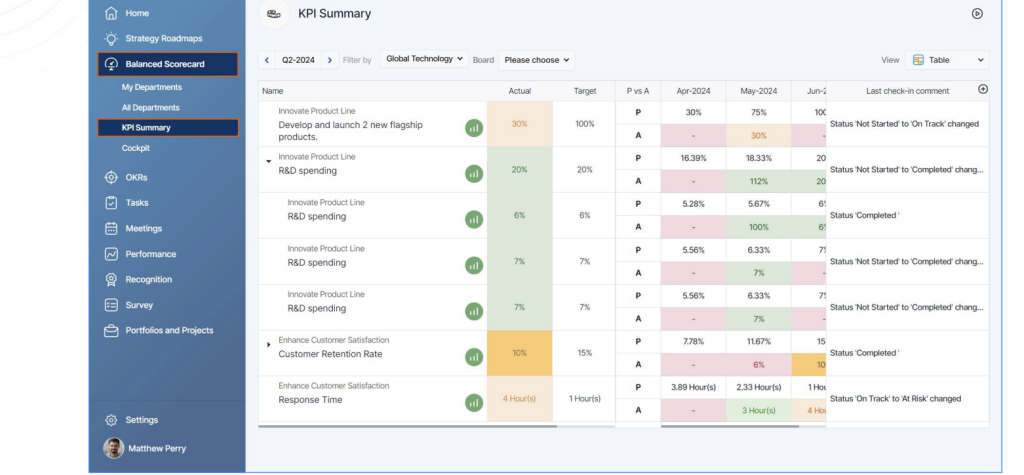
OKR implementation framework for UAE organisations displayed on a CRM dashboard with real-time goal progress.

Step 4 — OKR Coaching / Employee Training & Enablement

A platform only works if people actually use it well. We run practical training covering core OKR principles, how to log updates inside the system, and how to run efficient weekly check-ins. See our full OKR Training for UAE Teams guide for what this training covers in depth.

Step 5 — Establishing a Weekly & Quarterly OKR Rhythm

Consistency is what separates OKRs that stick from OKRs that fade by quarter two and this is where the platform does the heavy lifting instead of relying on willpower.

  • Weekly check-ins — automated prompts remind each owner to update their key results before the sync, so the 15-minute team meeting is spent discussing blockers, not chasing status updates
  • Monthly health checks — dashboards flag key results with dropping confidence scores automatically, surfacing at-risk goals before they become quarter-end surprises
  • Quarterly resets — historical scoring data from the platform makes the quarterly review a data conversation instead of a memory exercise, and next quarter’s objectives get built directly from what the numbers showed

Because the system tracks and reminds automatically, the rhythm survives busy weeks which is usually the exact point where spreadsheet-based OKR tracking quietly stops happening.

Step 6 — Handover to HR & Internal Champions

Once the system is running smoothly, we hand full control to your HR team and internal OKR champions including complete documentation, admin access, and governance guidelines so you’re not dependent on us to run future cycles.

What Changes When OKRs Live in a Platform Instead of a Spreadsheet

Most failed OKR rollouts don’t fail because the framework is wrong they fail because tracking depends entirely on someone remembering to update a document. A platform-based approach removes that dependency:

  • No status-chasing. Automated reminders replace the manager who has to ask “did you update your numbers yet?”
  • No version confusion. One live dashboard replaces five different spreadsheet copies floating around in email threads.
  • No end-of-quarter surprises. Confidence scores and progress tracking surface problems in week seven, not week thirteen.
  • No lost institutional knowledge. When someone leaves the team, their OKR history and context stay in the system instead of walking out the door with them.

This is the difference between OKRs as a quarterly event and OKRs as an operating habit.

Muhammad

Muhammad is a business and HR strategist specialising in global workforce solutions and UAE employment compliance. He writes for Zephora Consulting, helping organisations navigate international hiring with clarity, accuracy, and a practical, business-first approach.
Share Post :

Maybe You Like

OKR Implementation Roadmap
06Aug

OKR Implementation Roadmap

OKR Implementation Roadmap: A 90-Day Plan for UAE SMEs OKR Implementation Roadmap provides organizations with…

OKR Consulting Cost UAE | Pricing Guide for Businesses
04Aug

OKR Consulting Cost UAE |…

OKR Consulting Cost in UAE: A Complete Pricing Guide for Businesses Quick Summary In this…

OKR Training for UAE Teams
04Aug

OKR Training for UAE Teams

OKR Training for UAE Teams: What It Covers, Who Needs It, and What It Costs…

UAE Recruitment Trends 2026: What’s Next for Hiring
11Aug

UAE Recruitment Trends 2026: What’s Next for Hiring

UAE Recruitment Trends 2026: What’s Next for Hiring in a Rapidly Evolving Job Market As we approach 2026, the hiring…

How Reverse Recruitment Empowers Professionals in the UAE Job Market?
04Aug

How Reverse Recruitment Empowers Professionals in the UAE Job Market?

Reverse recruitment flips the traditional job‑search model on its head by empowering professionals to pitch their skills directly to employers,…

How to Write an ATS-Friendly Resume for UAE Employers
31Jul

How to Write an ATS-Friendly Resume for UAE Employers

To capture the attention of UAE recruiters, your resume must pass the Applicant Tracking System (ATS) and resonate with local…

Managing Downsizing with strategy and Empathy
23Jul

Managing Downsizing with strategy and Empathy

Managing Corporate Layoffs and Downsizing: A Strategic Leadership Approach Managing a corporate layoff or downsizing is a difficult and sensitive…

10 Essential HR Processes Every Business Needs in 2025
11Jul

10 Essential HR Processes Every Business Needs in 2025

Streamlining HR Processes for 2025 In 2025, companies that streamline their HR operations are more than 2.5 times more likely…

12 Most Common Recruitment Challenges and Solutions for HR Professionals
14Jun

12 Most Common Recruitment Challenges and Solutions for HR Professionals

12 Recruitment Challenges and How to Overcome Them Recruiting the right talent has never been more crucial or more difficult.…

1 5 6 7