OKRs (Objectives and Key Results): A Practical Guide for UAE Companies
OKRs (Objectives and Key Results) are a goal-setting framework that pairs a clear, ambitious goal with three to five measurable results that prove you reached it. Teams set them every quarter, review them weekly and score them at the end of the cycle. Google, Intel and LinkedIn use them, and more UAE companies now do too. Leaders in Dubai, Abu Dhabi and Riyadh use them to turn annual strategy into work their teams can actually do in the next 90 days.
This guide explains what OKRs are, how they differ from KPIs, how to write good ones, and what they look like inside UAE businesses.
What does OKR stand for?
OKR stands for Objectives and Key Results.
- Objective: what you want to achieve. It is qualitative, inspiring and time-bound. Example: “Become the payroll partner Dubai SMEs trust most.”
- Key Results: how you will know you got there. They are numeric and verifiable. Example: “Raise client retention from 82% to 92%.”
A useful test: the objective is the destination, and the key results are the mile markers that prove you arrived. If a key result can’t be measured at the end of the quarter, it isn’t a key result. It’s a task.
Where did OKRs come from?
Andy Grove created OKRs at Intel in the 1970s. John Doerr learned the method there and introduced it to Google in 1999, when the company had fewer than 50 employees. Doerr’s book Measure What Matters (2018) made the framework mainstream. In the Gulf, adoption accelerated as government entities and family groups pushed for measurable, transparent performance. That push is tied to national agendas such as Dubai’s D33 and Saudi Vision 2030.

How OKRs work: the quarterly cycle
- Set (week 0): leadership sets three to five company objectives. Teams draft their own OKRs that ladder up to them.
- Align (week 1): teams check for dependencies and overlaps across functions.
- Check in (weekly): owners update progress and confidence in a 15-minute meeting.
- Review (mid-quarter): leaders remove blockers and adjust key results only if the business context changed.
- Score and reflect (week 13): each key result is scored from 0.0 to 1.0. Teams record what they learned before setting the next cycle.
Scoring 0.6 to 0.7 on a stretch OKR is usually a success. Hitting 1.0 every quarter means the goals were too safe.
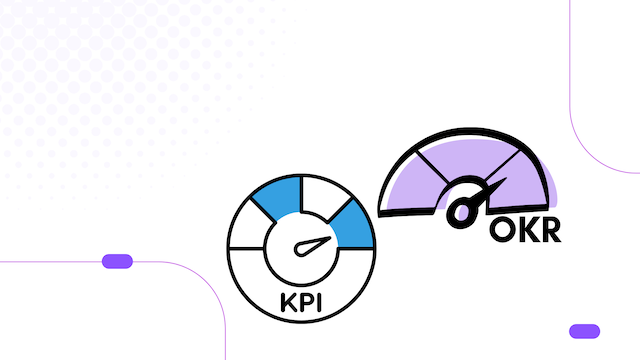
OKRs vs KPIs: what’s the difference?
UAE companies already run KPI scorecards, so this is the question we hear most. The short answer is that you need both.
| KPIs | OKRs | |
|---|---|---|
| Purpose | Monitor the health of business-as-usual | Drive change or improvement |
| Time frame | Ongoing | Usually quarterly |
| Ambition | Hit the target | Stretch beyond what’s comfortable |
| Example | Payroll processed by WPS deadline: 100% | Cut payroll query tickets from 120 to 40 per month |
| Link to pay | Often linked to appraisal | Best kept separate from bonus |
A KPI tells you the engine is running. An OKR tells you where you’re driving it next. When a KPI goes red, that is often the signal to write an OKR to fix it.
How to write good okrs objectives and key results (with a checklist)
Objectives should be:
- Qualitative and memorable. One sentence, no numbers.
- Ambitious but realistic within a quarter.
- Owned by one team, even if others contribute.
Key results should be:
- Outcomes, not activities. “Launch a new website” is a task. “Increase qualified leads from organic search from 15 to 40 per month” is a key result.
- Measurable from a source you already track: CRM, HRIS, Google Analytics or finance reports.
- Limited to three to five per objective.
Common mistakes:
- Turning every KPI into an OKR, so teams end up with 20 “objectives”.
- Cascading OKRs top-down only. The best OKR programs have about half of team OKRs drafted bottom-up.
- Linking OKR scores directly to bonuses. People then sandbag their targets and ambition disappears.
- Setting OKRs in January and not looking at them until December.
OKR examples for UAE companies
HR team (a Dubai SME with 120 employees)
Objective: Make our benefits a reason people stay.
- KR1: Raise benefits enrolment from 58% to 85% by end of quarter.
- KR2: Lift the benefits satisfaction score from 3.1 to 4.0 out of 5.
- KR3: Cut voluntary turnover in the first year of employment from 22% to 15% (annualised).
Sales team (B2B services, Abu Dhabi)
Objective: Win more mid-market accounts in Abu Dhabi.
- KR1: Grow the qualified pipeline from AED 1.2M to AED 2M.
- KR2: Increase the proposal win rate from 18% to 25%.
- KR3: Close five new accounts with more than 100 employees.
Real estate brokerage (Dubai)
Objective: Become the fastest-responding brokerage in Dubai Marina.
- KR1: Reduce average lead response time from 4 hours to 20 minutes.
- KR2: Increase the viewing-to-offer rate from 9% to 14%.
Hospitality group (UAE)
Objective: Deliver five-star service consistency across all properties.
- KR1: Raise the average guest review score from 4.3 to 4.6.
- KR2: Cut front-line staff turnover from 35% to 25% (annualised).
Emiratisation and nationalisation
Many UAE companies now carry Emiratisation targets set by MOHRE. Saudi entities carry Saudisation (Nitaqat) targets. Writing these as OKRs works better than tracking them as a compliance KPI alone. For example: “Build a pipeline of Emirati talent we’re proud of”, measured by hires, 12-month retention and internal promotions.

Making OKRs work in the UAE context
UAE workplaces have strengths and constraints that generic OKR guides don’t cover:
- Multinational teams: with 100+ nationalities in one office, write OKRs in plain English, and in Arabic where needed. Avoid slang and acronyms.
- Hierarchical decision-making: OKRs need visible sponsorship from the CEO or owner. Otherwise teams wait to be told what to write.
- Ramadan and summer: plan the quarter around reduced working hours and summer travel instead of pretending they don’t exist.
- Group structures: holdings with mainland, free zone and KSA entities need one shared set of company OKRs and separate entity-level OKRs.
- Government alignment: organisations working with government entities often map OKRs to D33 or Vision 2030 priorities to show strategic fit.
Ready to roll out OKRs? Our consultants help UAE companies design their first OKR cycle in four weeks. See how OKR implementation works
Do you need software to run OKRs?
Not at first. Most companies should run their first one or two cycles in a shared spreadsheet or slide deck. That way the habit forms before the tool arrives. Once more than 50 people are involved, a dedicated OKR platform or an HRIS module helps with alignment and weekly check-ins. Choose a tool after you know how your OKR rhythm works, not before.
When to bring in an OKR coach or consultant
Consider outside help when:
- Your first cycle stalled after the kickoff.
- Teams write task lists instead of outcomes.
- Leadership disagrees on the three to five company priorities.
- You need to link OKRs to performance reviews without turning them into a bonus scheme.
An experienced coach shortens the learning curve from three or four messy quarters to one or two. Read more about what an OKR consultant does or explore our OKR coaching services in Dubai.
Frequently asked questions about OKRs
Q1: What are OKRs in simple terms?
OKRs are a way of setting goals. You pick one ambitious objective and three to five measurable key results that show whether you achieved it, usually within a quarter.
Q2: How many OKRs should a team have?
One to three objectives per team per quarter, each with three to five key results. More than that usually means the team is listing tasks, not priorities.
Q3: Are OKRs the same as KPIs?
No. KPIs track ongoing performance, such as processing payroll on time. OKRs drive a specific improvement within a set period. Most companies use both.
Q4: Should OKRs be linked to salary or bonuses?
Generally no. A direct link encourages people to set safe targets. Use OKRs as one input to performance conversations, alongside behaviours and KPIs.
Q5: How long does it take to implement OKRs?
A first cycle can be designed in three to four weeks. Most organisations need two to three quarters before OKRs feel natural.
Q6: Do OKRs work for small businesses in Dubai?
Yes. Small teams often adopt OKRs faster because alignment is simpler. A 20-person company might run just one to three company OKRs and skip team-level OKRs altogether.
Turn your strategy into okrs objectives and key results that teams actually use
Zephora Consulting helps UAE and GCC organisations design, launch and coach OKR programs, from the first leadership workshop to the end-of-quarter review.